
Introduction: Earthworms — Nature’s Original Recyclers
Earthworms, often simply referred to as “worms,” are some of Earth’s most efficient recyclers. These underground dwellers thrive in dark, moist environments with an ample supply of organic matter—and in return, they create one of nature’s most potent fertilizers: worm castings.
In your compost bin, worms will eagerly consume old newspaper, coffee grounds, melon rinds, vegetable scraps, eggshells, and nearly all types of food waste. Their digestive systems break down this matter into nutrient-rich castings that supercharge plant growth.
How Worms Improve Soil and Unlock Nutrients
Worms are natural soil engineers. As they tunnel through the ground, they aerate compacted soil, improve water retention, and transport vital minerals from deeper layers to the surface.
While most soils contain abundant nutrients, many of these are not in a form that plants can use. Earthworms digest these inaccessible nutrients and convert them into bio-available forms through enzymatic activity in their gut. The result? Healthier, more productive soil.
The Perfect Design for Life Underground
Earthworms are built for life beneath the surface. Their tapered, limb-free bodies allow them to glide effortlessly through the soil. They have no eyes or ears—because in darkness, they don’t need them. Millions of years of evolution have produced a creature perfectly adapted to its role.
How Do Worms Eat?
Earthworms are like living compost machines. As they burrow, they ingest soil, minerals, and organic matter—often consuming their body weight in material each day.
Their digestive system, called the alimentary canal, stretches from mouth to tail and includes several specialized parts:
Buccal cavity: This cheek-like pouch contains taste cells and begins the digestive journey.
Pharynx: Acts as a suction pump, drawing food into the system.
Gullet and Crop: The crop temporarily stores food before passing it to the gizzard.
Gizzard: Grinds food using muscular action and ingested grit or sand.
Intestine: The site of nutrient absorption, lined with folds to increase surface area.
This efficient digestive system allows worms to process massive amounts of organic matter and enrich the soil with each movement.
A worm can ingest its own weight in earth, minerals, and organic matter each day, thus requiring an impressive digestive system. Worms have a digestive track that runs the length of their body called the alimentary canal. Different parts of the canal serve different purposes.
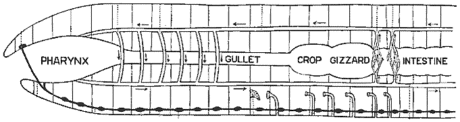 The first section that food travels to after the mouth opening is the buccal cavity or the cheek pouch. The taste cells are located in this area, which extends only to the first or second segment.
Following the buccal cavity is the pharynx. The pharynx extends to about the sixth segment and acts as kind of a suction pump that draws food from the buccal cavity.
Food then travels through the gullet and into the crop. The crop is a storage area for food before it enters the gizzard . Yes, I have asked the same thing, “Why does a worm need as storage organ”. Until we can speak worm, one can only hypothesize.
The crop then sends food to the gizzard which grinds up the food using powerful muscles. Sand and other mineral particles the worm consumes also helps to pulverize food.
Behind the gizzard begins the intestine. This is where the digestion and absorption takes place. A worm’s intestine, like our own, has many folds in the inner wall which gives the food greater chance for being fully absorbed.
What Are Worm Castings?
Worm castings are nutrient-rich droppings produced after worms digest organic material. Microorganisms like fungi, bacteria, and actinomycetes pre-digest this matter, breaking it down into simpler compounds that worms can absorb.
As the material passes through the worm’s gut, it gets coated with calcium and humic acid, creating a biologically active, slow-release fertilizer. USDA studies show that worm castings can contain up to eight times more nitrogen, phosphorus, and potassium than the surrounding soil.
These castings promote strong root development, improve soil structure, and support a thriving soil microbial community.
Why Are Worms Cool and Slimy?
Worms are cold-blooded, and their “sliminess” comes from a layer of mucus that helps them stay moist—a necessity for breathing and survival. This mucus also acts as a lubricant, allowing them to burrow through rough soils containing clay, roots, and stones.
During reproduction, worms secrete a special mucus to protect sperm and facilitate egg-laying. It’s more than just slime—it’s essential for their survival and reproduction.
How Do Worms Reproduce?
Earthworms are hermaphrodites, meaning each worm has both male and female reproductive organs. This allows any two adult worms of the same species to mate with each other.
Here’s how worm reproduction works:
When conditions like moisture and temperature are right, worms align and exchange sperm.
The clitellum (a thick band on their body) secretes mucus during mating, which later forms a protective cocoon for eggs.
After mating, each worm retains the sperm and uses it later to fertilize its eggs.
Worm cocoons hatch in 2–3 weeks under favorable conditions, producing baby worms that resemble tiny white threads.
These juveniles grow rapidly and reach maturity in about 90 days.
Types of Earthworms: Which Ones Are Used for Composting?
There are over 4,400 known species of earthworms, but not all of them are suitable for composting. Scientists categorize them into three main ecological groups:
Endogeic Worms (Soil-Dwellers)
Live deep in the mineral layers of the soil.
Build horizontal tunnels.
Rarely come to the surface.
Not ideal for composting.
Anecic Worms (Burrow-Builders)
Example: Canadian Nightcrawler (Lumbricus terrestris).
Create vertical burrows that reach the soil surface.
Drag surface litter down for feeding.
Slow to reproduce and not suited for high-density environments.
Not recommended for composting systems.
Epigeic Worms (Composting Worms)
Live on or near the soil surface.
Do not build permanent burrows.
Thrive in organic matter and changing environments.
Fast reproducers, tolerate high densities.
Best suited for vermicomposting.
Popular epigeic composting worms include:
Red Wigglers
- African Nightcrawlers
European Nightcrawlers
These species are ideal for converting kitchen scraps into rich vermicompost.
Final Thoughts: Why Worms Matter
Earthworms are essential allies in sustainable gardening and soil restoration. Whether they’re tunneling through clay soil or devouring kitchen waste in a compost bin, worms enhance soil health, support plant growth, and help us recycle organic matter naturally.
Want to create your own worm composting system? Start by choosing the right species and feeding them a balanced diet of kitchen scraps and paper-based bedding. Your garden—and the planet—will thank you.